
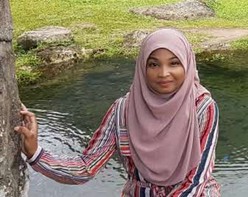
Engineer Safiyyah Abdullah, BSc, MSc., R.Eng.
The Board of Engineering of Trinidad and Tobago (BOETT) is proud to recognize another significant milestone in the advancement of specialist engineering practice with the registration of Engineer Safiyyah Abdullah as the country’s first Registered Specialist Water Supply Engineer.
Engineer Abdullah’s professional journey is a compelling example of how engineering competence is ultimately defined not only by academic qualification, but by sustained practice, experience, and demonstrated responsibility in a specialized field. With a BSc in Chemical Engineering and an MSc in Environmental Engineering, her early career path did not point to a single, clearly defined professional category. However, through years of dedicated service in the water sector, she developed deep expertise in water production, treatment optimization, and distribution system management.
Her career at the Water and Sewerage Authority (WASA), progressing from Graduate Engineer to Manager – Water Production, reflects a steady accumulation of technical competence and leadership responsibility. Her work has included improving water treatment processes, optimizing plant performance, and contributing to major infrastructure upgrades and network redesign—efforts that directly impact water quality, reliability, and public health.
A defining aspect of Engineer Abdullah’s journey was the question of professional identity—whether her qualifications aligned with Chemical Engineering or Environmental Engineering for the purposes of registration. Through BOETT’s competency-based assessment, it was ultimately determined that her core engineering practice and demonstrable expertise lay in Water Supply Engineering, leading to her registration in this specialist category.
Water supply engineering is fundamental to national development, public health, and environmental sustainability. It requires not only strong technical capability in hydraulics, treatment processes, and system design, but also sound engineering judgement, accountability, and a commitment to safeguarding the public. The BOETT’s recognition of this discipline as a specialist category reinforces the importance of ensuring that such critical systems are designed, managed, and operated by competent professionals.
In this interview with the BOETT, Engineer Abdullah reflects on her unique career journey, the challenges of navigating a non-traditional professional pathway, and the experiences that shaped her into a specialist in water supply engineering. Her story stands as both a pioneering achievement and an inspiration to engineers pursuing clarity, purpose, and excellence in their professional practice.
Q1. Firstly, congratulations on becoming the first engineer registered by the BOETT as a Specialist Water Supply Engineer. What does this achievement mean to you personally and professionally?
Thank you so much! This truly means a great deal. On a personal level, it is a validation of over 18 years of dedication to a field that I stumbled into, but grew to love. Water is life, and to have my commitment to that recognised in such a formal and meaningful way is something I am genuinely proud of. Professionally, it means to me that the work I have been doing such as managing treatment plants, developing policies, leading teams, working with my peers, has met a standard that can be independently verified. That matters, especially in an era where we need to elevate engineering practice in Trinidad & Tobago.
Q2. How do you view this milestone in terms of advancing the recognition of water supply engineering as a distinct and critical area of practice in Trinidad and Tobago?
I think it is an important step forward. For a long time, water supply engineering has been treated as a subset of civil or environmental engineering. When I entered the water industry in Trinidad, my mentor was also a Chemical Engineer and deviated into the water industry himself. He said that the engineering discipline in the water industry did not have a clear identity of its own. So BOETT’s decision to create a specialist registration category sends a strong signal to those that are now graduating and are interested in the field, that this discipline requires dedicated expertise. It is not simply about pipes and pumps, it incorporates water hydrology, quality, public health, compliance, climate resilience, storage mechanisms and so much more. Being the first to be registered in this category, I do hope that it opens the door for many others to follow and for the profession to gain the recognition it deserves nationally.
Q3. Your academic training is in Chemical Engineering and Environmental Engineering. At what point did your career begin to align specifically with water supply engineering?
It happened quite organically, I think. I joined WASA in 2007 as a Graduate Engineer Trainee, and from the outset I was immersed in water treatment and in water production principles. My Chemical Engineering background gave me a strong foundation in process systems and water treatment chemistry, and that followed my postgraduate work in Environmental Engineering which deepened my understanding of water quality, sustainability and climate resilience. By that time, I was the sole engineer at the Caroni Water Treatment Plant, which is largest in the English-speaking Caribbean. I found my calling there and I knew this direction was for me. Me being at Caroni was pivotal; it demanded that I think holistically about every aspect of water supply, from storage to point source to consumer. It actually demanded a lot, but I am grateful to have my start there and the experience was what shaped my alignment.
Q4. How did your postgraduate training in Environmental Engineering complement your work in water production and treatment systems?
It filled in critical gaps that pure chemical or process engineering training did not address. My M.Sc. research on the properties of Moringa oleifera, for instance, connected directly to exploring natural coagulants in water treatment. Where I was, we depended heavily on chemical-based coagulants and flocculant, so my research was a practical area of interest. The postgraduate programme also sharpened my ability to think about the environmental context of water systems, catchment management, aquifer sustainability, impounding reservoir impacts, pollution concerns, effluent discharge and its impact on the water cycle. Those lenses have been invaluable in my career. Especially in developing water management programmes and in the research papers I got the opportunity to author, during my time as a trainee engineer at WASA.
Q5. Your career at WASA reflects progressive responsibility from graduate engineer to Manager – Water Production. What key experiences contributed most to your development as a water supply engineer?
There are a few that stand out. I was the Production Engineer in Northwest Trinidad for five years. Northwest required dedication, commitment and a level of discipline that I had to grow into. I then transitioned to the Senior Engineer at Caroni WTP where the weight of that progressive responsibility really forced me to develop quickly and to rely on my own judgement while also learning how to lead and coordinate large teams. Another formative experience was overseeing several key treatment facilities in the North-East and Central, which gave me length and breadth across very different system types, different point sources. And then there were the research contributions in my early years, writing papers on alternative disinfection technologies, wastewater-to-potable water technologies and catchment assessments. This actually taught me to question established approaches and look for better solutions. Each role built on the last and expanded both my technical and leadership toolkit.
Q6. Can you describe your involvement in improving water treatment processes and how your work contributed to measurable improvements in water quality and system performance?
Certainly. Across my career I have been able to point to some quite concrete outcomes. At the Caroni plant, for example, we achieved both operational efficiency during my time there and a significant improvement in water quality compliance through a combination of better chemical optimisation strategies, revised standard operating procedures, and improved monitoring protocols. I also implemented several key quality management policies that helped us reach compliance with regulatory standards and reduce water quality incidents by around 25%. A big part of this evolved from both analytical research on trends to understanding treatment and pressure patterns, which informed smarter resource planning. Although this may be the kind of work that doesn’t get headlines, it directly impacts the quality and quantity of water that reaches people’s taps every day and knowing that customers can benefit from improvements was my driving force to continue and push on.
Q7. You have also led system redesign and network upgrades. What were some of the engineering challenges involved in projects such as the redesign of the Sangre Grande to Manzanilla water supply network?
Network redesign projects like that one is never straightforward, there are just so many moving parts. You’re working with old infrastructure, difficult terrain, and water demand that changes depending on the time of year, the season, all while trying to make sure people still have water while the work is going on. In the North-East corridor, a big part of the challenge was making sure that new booster stations in places like Manzanilla, Aripo, and Golden Grove, would actually work the way they were supposed to, once they were up and running. That meant working closely with the hydraulic modelling teams, distribution personnel, managing your team and contractors, but it also meant dealing with regulatory requirements, and keeping communities, our customers, informed as best as we could along the way.
Budget and scheduling pressures were always in the background too. But honestly, what I remember most is the problem-solving. There were times we had to get creative about how we operated and managed certain stations to get the results we needed. Some things worked, some things didn’t, but when something didn’t work, we had to regroup, sit down, analyse and figure out why, and then come back with a better approach. That back-and-forth, that willingness to keep trying until you get it right, is really what carried those projects through. I had a great team to work with, that was also motivated, and that helped a lot.
Q8. Water supply engineering spans treatment, distribution, and system management. Which areas have been the most technically demanding in your experience?
Honestly, distribution is the area I find most demanding and, in some ways, the most underappreciated. Treatment is complex, but more controllable: you have a plant, defined inputs, and processes you can regulate and control. Distribution is dynamic and sprawling and anything can influence something. Pressure fluctuations, network losses, consumer demand spikes, aging pipes, all of these interact in ways that are difficult to model and even harder to manage or predict in real time. Dry season water management, in particular, is where the technical challenge peaks and sometimes where distribution gets the most critical. We have to make very deliberate decisions about water allocation and priority while trying to serve residential, agricultural, and commercial users equitably. That balancing act, under resource constraints during seasons, is where I believe the full weight of water supply engineering has the greatest demands.
Q9. As Manager – Water Production, how do you balance operational demands with engineering decision-making and long-term system reliability?
As Manager, you require structure, communication, order, planning and compliance. On the operational side, developing comprehensive plans for both seasons, for the work teams and for treatment facilities actually assists in daily monitoring of production and asset maintenance scheduling. The output is a clear framework for day-to-day activities and decisions so that the team can operate with confidence and consistency. On the strategic side, I carved out space for engineering analysis even in the middle of operational pressures. That meant integrating all aspects and tools to reduce reactive firefighting measures. This allowed my team to be more proactive. I was also heavily invested in my team’s development, because a capable team means a strong team. A strong team makes the difference when it comes to emergencies, and I can trust they can focus on operational execution while I can focus on longer-term reliability and planning. It is never perfectly balanced, but the goal is to ensure that short-term issues do not crowd out long-term thinking.
Q10. What were some of the key challenges you encountered in transitioning from a general engineering background into a specialized water supply role?
The depth of knowledge required was the first real challenge. Chemical and environmental engineering gives you a strong foundation in water chemistry, but water supply has its own body of knowledge, where water treatment chemistry is specific to source water characteristics. It took focus on-the-ground learning so that I was able to understand the requirement for water supply in its reality. The second challenge was the human side: leading multi-disciplinary teams in a utility environment where there are strong operational and maintenance cultures already in place, was an adjustment. Learning how to earn trust, influence without always having authority or even without having the loudest voice in the room yet being able to communicate technical decisions to everyone in a room from both technical to non-technical staffers, was its own form of engineering. I think the third was the ambiguity: water supply often involves managing uncertainty, whether about rainfall, storage, demand, or equipment performance, and learning to make good decisions with incomplete information is a skill you have to consciously develop and trust in.
Q11. Water supply systems are critical national infrastructure. What are some of the most complex or high-risk challenges you have had to manage in your career?
Dry season management is one that consistently tests us every year. Some years are better than others but there are instances when reservoir levels drop and demand does not, you have to make difficult decisions that affect people’s daily lives. Managing chemical supply for treatment is another area of risk — where any disruption in chemical supply can compromise treatment quality and water supply compliance with immediate public health implications. And then there are the engineering failures that happen suddenly, especially in large, aging infrastructure – responding to those under pressure, with limited or no resources and high public visibility, is genuinely challenging. Those moments are where the depth of your engineering knowledge, the trust of your team’s delivery and your leadership capacity are all tested simultaneously.
Q12. Can you describe your experience going through the BOETT competency assessment process, particularly given your interdisciplinary academic background?
It was a rigorous. I had to remember and recall things that I sometimes didn’t believe occurred!! But the experience was truly rewarding. The interdisciplinary background meant I had to clearly define how my training and experience mapped to the specific competencies required for Specialist Water Supply registration. That required a degree of self-reflection, being able to demonstrate not just that I had done the work, but that I understood the engineering principles underpinning each area of practice. My background in chemical and environmental engineering is not a conventional path into water supply, so I had to show the thread that connected my academic formation to my professional development. The process with BOETT was fair and professionally conducted, and it reinforced for me the value of having a formal body that can independently assess and validate engineering competence in Trinidad and Tobago.
Q13. How do you see the role of water supply engineering evolving in Trinidad and Tobago, particularly in the context of climate variability, infrastructure challenges, and growing demand?
Climate variability is perhaps the defining challenge of this generation and the next generation of water supply engineering in T&T. Our traditional assumptions about rainfall patterns, catchment yields, and dry season severity are all being disrupted and are evolving constantly. What we think we know and can predict, we don’t. Engineers in this field will need to become much more fluent in climate modelling and adaptive infrastructure design. We can no longer plan purely on historical data, as this may not always predict what can occur in the future. On the demand side, population growth, increased industrial activity and pollution considerations all mean we need to think more seriously about water efficiency, reuse, and other non-conventional sources. On the infrastructure side, the backlog of aging assets requires a strategic asset management approach that prioritises investment based on risk, monitoring and criticality. I also think the integration of digital tools like real-time monitoring, SCADA systems, data analytics and AI will fundamentally change how we manage and interpret water systems, and our engineers need to be equipped for that future.
Q14. What improvements would you like to see in water infrastructure planning, asset management, or regulatory oversight?
I would love to see a more formalised national water infrastructure plan. One that is long-term, holistic, data-driven, and updated regularly based on actual performance data and changing conditions. Right now, planning can be reactive, driven by crisis rather than long-term strategy. On asset management side of things, there needs to be investment in condition monitoring and assessment and lifecycle planning. So, we are not always surprised by failures with aging infrastructure and equipment. Regulatory oversight could also be strengthened to hold utilities accountable to clear service standards, once adequate monitoring principles are employed but will also enable the kind of investment that may be needed for improvement. I also think that greater engagement between regulatory bodies, engineering professionals, and academia would enrich policymaking. There is a great avenue for growth in the water industry with a lot of local knowledge and research capacity that is not fully utilised, but I believe can help shape our water sector governance.
Q15. Finally, as the first Specialist Water Supply Engineer registered by the BOETT, how would you like your contribution to the profession and to national development to be remembered?
I hope it is remembered as more than just being first! I would like it to be remembered as a moment that helped to shift how we think about water engineering in Trinidad and Tobago. That this sparked a conversation about the importance of specialisation, of professional standards and development, and of recognising the critical role that water supply engineers play in national development. If my registration encourages other engineers to pursue specialist accreditation, and if it contributes in some small way to elevating the quality and professionalism of water sector engineering in T&T, well then that would be a legacy I would be proud of! Water is fundamental to every aspect of life and the engineers who are lucky enough to manage it deserve to be recognised and empowered because of it!