
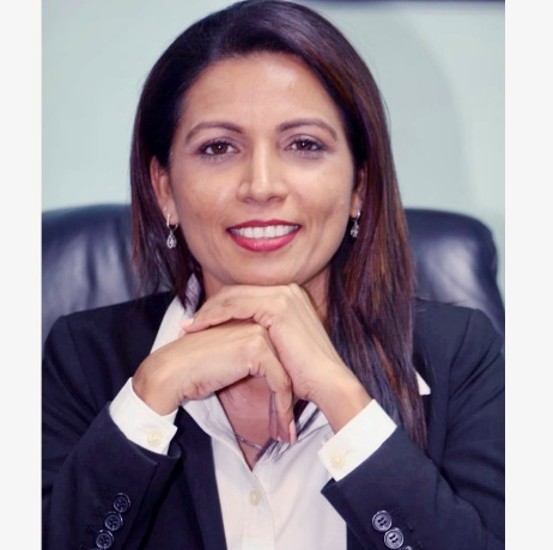
Engineer Tara Manick – B.Sc., M.Sc. PMP(2008), CEM(2015), LLB, MSME., R.Eng.,
The Board of Engineering of Trinidad and Tobago (BOETT) is proud to celebrate International Women in Engineering Day JUNE 23rd 2026 (INWED 2026) by featuring Eng. Tara Manick, a distinguished Registered Engineer, business leader, and advocate for sustainable innovation whose career exemplifies this year’s theme: “Engineering Intelligence.”
With more than twenty-five years of professional experience spanning engineering, renewable energy, telecommunications, project management, law, and business leadership, Eng. Manick represents a new generation of multidisciplinary engineering professionals who combine technical expertise with strategic thinking, ethical leadership, and a commitment to continuous learning. As Managing Director of Engineering and Clean Technologies Limited, she has successfully led initiatives in renewable energy, energy efficiency, ICT solutions, and sustainable technologies, helping organizations reduce costs, improve performance, and lower environmental impact while advancing Trinidad and Tobago’s transition toward a more sustainable future.
What distinguishes Eng. Manick’s professional journey is her ability to integrate knowledge across disciplines. Holding qualifications in engineering, management, law, project management, and energy management, she embodies the concept of “Engineering Intelligence”—the application of technical knowledge, data-driven decision-making, systems thinking, and emerging technologies to solve increasingly complex challenges. Her leadership philosophy reflects the evolving role of engineers as innovators, problem-solvers, entrepreneurs, and stewards of sustainable development.
Throughout her career, Eng. Manick has championed the value of multidisciplinary thinking, ethical responsibility, and lifelong professional development. She has consistently demonstrated how engineers can bridge the worlds of technology, business, governance, and sustainability to create meaningful impact for organizations, communities, and future generations.
In this special INWED 2026 feature, Eng. Manick reflects on her professional journey, the lessons learned from leading multidisciplinary teams, the opportunities emerging from the global energy transition, and the transformative role that artificial intelligence, digital technologies, and sustainability will play in shaping the future of engineering. She also shares valuable insights for young women considering engineering careers and highlights the importance of resilience, authenticity, and continuous growth in professional success.
The BOETT is honoured to recognize Eng. Tara Manick as one of Trinidad and Tobago’s outstanding women engineers whose achievements continue to inspire the profession and demonstrate the power of engineering intelligence in building a smarter, more sustainable, and more resilient future.
Q1. What initially inspired you to pursue a career in electrical engineering, and how did that passion evolve over time?
My lifelong passion for the sciences shaped my secondary education with a heavy focus in Biology, Chemistry, and Physics.
I initially considered three career paths: Psychology, Medicine, and Engineering. In the end, practical factors such as tuition costs and long-term career opportunities guided my decision toward engineering. When selecting a specialization, I remember asking which route was the most demanding—and that is exactly how I chose Electrical and Computer Engineering. My first degree in Engineering focused on Controls and Communication Systems, while my second degree specialized strictly in Communication Systems.
Over my first fifteen years in the industry, I learned that technology evolves rapidly, requiring constant re-certification, while ICT projects – though smaller in scale and budget – carry significantly higher failure risks than other engineering disciplines. A major project in 2008 sparked my passion for renewable energy and shifted my professional focus toward sustainable solutions. The combined experience gained in sales, project management, engineering and the corporate world ultimately motivated me to my own business.
Q2. Reflecting on your 25+ years of experience, what were some defining moments that shaped your professional journey?
Several defining moments shaped the direction of my professional journey. Growing up in an entrepreneurial family, I witnessed firsthand the hardships of business ownership during a recession, which initially motivated me to pursue a stable corporate career. During my academic training, one lecturer profoundly influenced my perspective by teaching that success is not about memorizing information, but about knowing where to find it and how to apply it effectively. Early training in project management immediately after university gave me a structured and repeatable approach to problem-solving, leading to more grounded and consistent results. Later, while working at TSTT, the Sales Department mantra, “Communicate, communicate, and communicate some more”, taught me the importance of transparency in managing complex challenges. My work experience in Canada further broadened my perspective on productivity and reinforced the critical importance of “ Values and Ethics”, and “Engineering Law” within the profession. Ultimately, my transition into business ownership marked a complete turning point in my career, driven by a desire to be more effective in my undertaking and a growing aversion to corporate politics.
Q3. As a registered engineer and business leader, how has your engineering foundation influenced your decision-making at the executive level?
Throughout my career, I have developed the ability to analyze organizational challenges from multiple perspectives. My engineering education provided a first-principles approach to systemic thinking, allowing me to understand how information, processes, and resources flow through an organization from input to output. This analytical foundation was strengthened through Business Process Re-engineering training, which taught me how to align a company’s operational processes with its core values and strategic objectives. Along the way, an academic mentor shared a lesson about knowing how to locate, interpret, and apply data effectively.
Combining engineering with Project Management gave me a structured approach to making complex initiatives more repeatable and efficient. Later, my management studies expanded my ability to scale operations, solve systemic problems, and integrate ethics into decision-making. Today, by combining technical, legal, and IT expertise, I am equipped to navigate complex challenges and implement automation that improves efficiency and performance.
Q4. As Managing Director of Engineering and Clean Technologies Limited, how do you balance technical excellence with strategic business leadership?
As Managing Director of Engineering and Clean Technologies Limited, I balance technical expertise with corporate strategy on a daily basis. Over the years, I have combined my engineering background with legal training, management studies, and extensive Project Management experience to guide both business and technical decisions. My leadership approach is built on multidisciplinary decision-making, systems thinking, measurable outcomes, and empowering others. I view engineering not only as a support function, but as a business enabler that must align with legal, financial, and strategic goals. With more than 25 years of experience across SMEs and large corporations, I focus on governance, planning, and delivering practical solutions that improve energy efficiency, reduce costs, and lower environmental impact. At the same time, I foster a collaborative and transparent environment that empowers my team to manage technical execution while I focus on driving the company’s long-term vision forward.
Q5. What leadership principles have guided you in managing multidisciplinary teams across engineering, ICT, and renewable energy sectors?
Over the years, I have had the privilege of leading diverse teams across engineering, ICT, and renewable energy, although my primary focus has since shifted away from ICT. My leadership philosophy centers on building cohesive and competent teams that can work effectively across technical disciplines. To achieve this, I apply the Situational Leadership approach, adapting my management style to the competence and commitment of each team member, while reinforcing execution through strong project management principles.
I believe technology must be practical, user-focused, and economically viable. Drawing on my PMP background, I encourage teams to understand the bigger picture and how their individual contributions support overall success. I am also strongly results-driven, maintaining focus on outcomes even in complex and high-risk environments. Finally, because of my multidisciplinary background in law, management, and engineering, I encourage cross-functional learning and push team members to look beyond their technical silos to better understand the legal, governance, and strategic factors that shape our decisions.
Q6. Your work spans renewable energy, energy efficiency, and solar technologies. What role do you see engineers playing in advancing sustainable development in Trinidad and Tobago?
Trinidad and Tobago remains in the early stages of energy efficiency and renewable energy development, with significant progress still needed in both regulation and implementation. In my view, the role of engineers extends far beyond technical installations; they must serve as socioeconomic drivers of the country’s green energy transition.
Engineers play a critical role in shaping practical and safe regulatory frameworks for renewable energy, energy storage, and efficiency technologies by combining technical expertise with real-world business experience.
They are also central to building a smarter and more decentralized energy network, where businesses and communities can generate and manage clean energy more independently.
In addition, engineers are essential to modernizing Trinidad and Tobago’s industrial sector by integrating renewable technologies that improve energy efficiency, reduce carbon emissions, and create greater economic value from natural gas resources.
Beyond energy generation, engineers contribute through conservation initiatives such as energy audits and efficient lighting and cooling systems, helping to reduce both operational costs and environmental impact.
In the Caribbean context, engineers must also design resilient, future-ready infrastructure capable of withstanding climate-related challenges while protecting environmental and ecological sustainability.
Q7. What opportunities do you see for young engineers in the evolving energy landscape?
The modern energy transition requires young engineers to evolve beyond traditional power engineering roles and become multidimensional problem solvers. Drawing from the experience of Engineering and Clean Technologies Limited, I believe the greatest opportunities lie at the intersection of renewable energy, digitalization, and sustainability.
Young engineers can move from being technical service providers to energy entrepreneurs by developing decentralized energy solutions such as microgrids for communities and SMEs and offering energy as a service.
The growing integration of ICT and power systems also creates major opportunities in smart grid technologies, including IoT-based energy monitoring, data analytics, and cybersecurity for critical infrastructure.
In addition, engineers who specialize in energy efficiency and auditing can help organizations reduce costs and carbon emissions through intelligent retrofitting and optimized energy management.
There is also increasing demand for professionals who can bridge the gap between engineering, policy, and regulation by understanding environmental compliance and requisite types of agreements.
Finally, the future of sustainable engineering will depend on lifecycle thinking, including the recycling and repurposing of renewable energy technologies such as solar components and EV batteries, ensuring that clean energy development remains environmentally responsible and aligned with the needs of Caribbean societies.
Q8. What has been your experience as a woman in engineering and executive leadership in traditionally male-dominated environments?
My perspective on navigating male-dominated environments was shaped early on. Growing up with six older brothers and working in my family’s welding and fabrication business, I was immersed in a traditionally male environment from childhood. At a young age, I was already directing an entirely male workforce. Because of this, I never viewed the workplace through the lens of gender; I simply saw individuals and workers. I always regarded myself as an equal and developed a natural immunity to typical gender dynamics.
Carrying this mindset into the corporate world made it easy for me to collaborate and lead effectively across any capacity or environment. Furthermore, I believe corporate culture heavily dictates a woman’s professional experience. Fortunately, the organizations I have served possessed mature corporate cultures and prioritized rigorous HR policies. Finally, operating consistently in professional and executive leadership roles naturally established a standard of mutual respect, precluding unprofessional behaviour.
Q9. What message would you share with young women considering a career in engineering today?
Today, a career in engineering for women is no longer an exception but an increasingly common reality. Reflecting on my own experiences, I believe young female engineers should embrace their unique perspectives as strengths rather than obstacles, because the profession benefits greatly from diverse ideas, empathy, and collaboration.
Women should never feel the need to change who they are to fit into traditionally male-dominated spaces; authenticity, curiosity, and confidence are essential qualities that help move the industry forward.
While engineering is academically demanding, the focus should remain on the impact the profession has on society—from developing systems to designing safer and more sustainable communities.
I also strongly encourage young professionals to build supportive networks by seeking mentors, engaging with professional communities, and supporting one another’s growth and success.
At the same time, it is important not to allow gender or cultural differences to create unnecessary barriers in the workplace. Instead, learning to adapt communication and leadership styles across diverse teams is a critical skill that strengthens collaboration and influence.
To every young woman considering engineering today, I would say this: the world needs your ideas, your perspective, and your solutions. Be bold, remain curious, and recognize that an engineering degree is not just a qualification, but a powerful opportunity to help solve some of the world’s most pressing challenges.
Q10. You hold multiple qualifications across engineering, management, law, and project management. How important is continuous professional development in today’s engineering landscape?
Continuous Professional Development (CPD)—whether through formal certifications, professional body involvement, self-directed research, or hands-on mentorship—is essential to remaining relevant in today’s rapidly evolving engineering landscape. As engineers progress into increasingly technical or managerial roles, the competencies required for success evolve significantly.
Throughout my career, I have intentionally used CPD to bridge my skills gaps which naturally led to further skills in a multidisciplinary background in engineering, project management, law, business management, and, more recently, artificial intelligence.
Early in my career, I combined engineering with Project Management Professional (PMP) training to improve technical execution and risk management, and my involvement with the Project Management Institute Southern Caribbean Chapter reinforced the importance of project management as a critical professional skill. Later, exposure to legal and ethical training in engineering motivated me to pursue formal legal training, enabling me to better navigate legal risks and communicate effectively with corporate attorneys and contractors.
Founding Engineering and Clean Technologies Limited further pushed me to expand into business governance and strategy through a Master’s degree in SME Management. Today, with AI rapidly transforming industries, I continue developing AI-related skills while encouraging my staff to do the same to maintain competitiveness.
Engineering is fundamentally a lifelong learning profession, especially in fast-moving sectors such as communications, renewable energy, and digital technologies. This broad, cross-functional learning approach has strengthened my ability to solve problems holistically.
My experience across engineering, law, management, and technology has taught me that the most effective solutions are often found at the intersection of multiple disciplines.
In today’s environment, modern engineering challenges are rarely solved within the boundaries of a single field. Continuous professional development is therefore not simply about acquiring additional qualifications; it is about expanding one’s capacity to lead, innovate, and contribute meaningfully to society in an increasingly complex and interconnected world.
Q11. How has your multidisciplinary background (engineering, law, management) enhanced your effectiveness as a leader?
My multidisciplinary background allows me to bridge the gap between technical teams and executive leadership. Rather than viewing projects in isolation, I assess their technical, legal, financial, and operational implications together. This integrated perspective supports balanced decision-making and effective leadership across complex projects.
My leadership approach is built on three core strengths: legal risk management, strategic business alignment, and analytical engineering problem-solving.
With a Bachelor of Laws (LLB), I bring an understanding of the legal and contractual issues that are often overlooked in technical projects. This enables me to lead contract negotiations with a clear focus on liability management, intellectual property protection, and regulatory compliance. My legal background also strengthens my ability to resolve procurement disputes and contractual challenges proactively, protecting the organization’s interests while maintaining critical professional relationships.
My management training ensures I focus not only on technical delivery, but also on business value. I align engineering initiatives with organizational objectives and communicate technical outcomes in terms of ROI, KPIs, and long-term growth.
My engineering foundation provides the analytical structure that supports my work across all disciplines. I apply systematic problem-solving and first-principles thinking to identify root causes, evaluate impacts, and implement sustainable solutions. Viewing organizations as interconnected systems also allows me to anticipate the operational effects of legal or management decisions.
Engineering taught me how to build, management taught me why we build, and law taught me the rules that govern the process. Together, these disciplines allow me to break down silos, reduce organizational friction, and lead effectively in complex environments.
Q12. As a registered engineer, what does professional responsibility mean to you in practice?
Being a registered engineer is a lifelong commitment to serving as a steward of public trust, grounded in the belief that if a solution is not ethical, sustainable, and safe, it is not an engineering solution. In daily practice, this responsibility begins with a duty of care that extends beyond the contract. This requires the courage to halt a project or challenge a timeline if safety standards are at risk, ensuring that technical specifications are never compromised for short-term cost savings.
This commitment to integrity is backed by rigorous ethical leadership and personal accountability. A professional engineering seal carries immense weight; thus, I take ownership of my decisions and stand firmly behind the technical validity of my work. True accountability also means practicing with total transparency. I am honest about technical limitations and proactively engage specialists when a project demands niche expertise outside my immediate scope.
Finally, in the modern engineering landscape, professional responsibility must include environmental stewardship. As a professional in Clean Technologies, I view sustainability not as an afterthought, but as a professional mandate to build resilient, future-proof systems. This means actively minimizing the carbon footprint of engineering works and championing high-efficiency energy solutions specifically optimized for the unique challenges of the Caribbean ecosystem.
Q13. Looking ahead, what trends do you believe will most significantly impact the engineering profession over the next decade?
The engineering landscape is undergoing a massive shift from traditional, isolated practices to a digitally integrated, planet-first model.
Central to this transformation is the proliferation of artificial intelligence and digital twins, transitioning AI from a futuristic concept into an essential daily teammate. By leveraging machine learning, the profession is moving swiftly from reactive fixes to predictive operations, allowing us to identify asset failures in power grids or manufacturing plants before they ever occur. Furthermore, the adoption of digital twins as a standard tool allows engineers to build virtual replicas of physical assets. This lets teams simulate performance and troubleshoot in risk-free virtual environments before breaking ground.
At the same time, sustainability is transitioning from an optional feature to a mandatory core engineering requirement. Modern engineers find themselves at the absolute forefront of the race to net-zero, pioneering advancements in long-duration energy storage and carbon-capture technologies. This shift demands a commitment to lifecycle engineering, where products and infrastructure are built specifically for a circular economy that prioritizes reuse.
This green transition is further amplified by smart infrastructure and the Internet of Things (IoT). By embedding sensors into static buildings, we can turn them into intelligent, self-optimizing networks. In connected cities, smart grids and autonomous water management systems adjust distribution in real-time, drastically reducing waste and boosting our resilience against severe climate events.
Ultimately, these advancements are forcing a deep convergence of disciplines where traditional professional boundaries are rapidly blurring. The next decade will belong to multidisciplinary engineers who can seamlessly navigate AI ethics, data analytics, and human-centric design. True success will require professionals to blend deep technical roots with the leadership and legal literacy necessary to manage complex, automated global systems.
Moving forward, we must be more than just technical experts; we must be data architects and environmental stewards. The engineering profession is evolving from “building things right” to “building the right things”—solutions that are intelligent, interconnected, and sustainable for the generations to follow.
Q14. What motivates you to continue striving for excellence after such an accomplished career?
I do not view excellence as a destination I have already reached, but as a moving target. While personal growth motivated me at twenty, my drive today is centered mainly on impact. Whether I am advancing clean energy through Engineering and Clean Technologies Ltd or mentoring the next generation, the work itself is the reward. Now, my deepest motivation stems from being a holistic role model for future female leaders, especially my daughter. To me, true excellence extends far beyond academic or financial milestones; it requires being authentic to your whole self and protecting your personal ecosystem. I define excellence by the peace, joy, and ease I feel while performing at my highest level. It means embracing my shortcomings, knowing when to retool, refusing to conform to stereotypes, and remembering that life is not a rat race. We must write our own stories.
This philosophy directly shapes how I approach my career. Raised on the principle of “waste not, want not,” my first experience in renewable energy opened my eyes to the staggering amount of systemic waste, alongside the immense potential for efficiency. Recognizing these opportunities drove me to pivot my career so I could actively contribute to a sustainable energy future.
In doing so, I have found immense fulfilment in making a tangible difference in the lives of the people within my immediate ecosystem. As an entrepreneur, this impact takes several forms, from delivering real economic value to our clients through products and solutions, to actively uplifting and improving the livelihoods of the people I employ.
Ultimately, my daily energy is sustained by intellectual curiosity and a strict commitment to professional stewardship. I am genuinely energized by the intersection of different fields—whether that means finding a legal solution to a technical bottleneck or applying a management strategy to solve an engineering problem. For me, excellence is simply the byproduct of continuous learning.
This curiosity is balanced by the responsibility that comes with being a professional engineer. It is a lifelong commitment to safety, sustainability, and integrity. Knowing that my work directly impacts the reliability of our infrastructure and the safety of our citizens is what drives me to keep striving for a higher standard every single day.
Q15. Finally, how do you maintain balance between professional responsibilities and personal well-being?
I am a firm believer in work-life balance, viewing it not as a static 50/50 split, but as a dynamic integration of my roles as a leader, professional, and individual. Guided by the same systemic thinking I apply to engineering, I believe everyone must determine their unique formula for a happy, healthy, and purposeful life.
To achieve this, I apply my PMP training directly to my personal well-being, treating self-care as a critical project milestone. This “Aha!” moment crystallized during my pregnancy, when a colleague noted I was managing it like a major project. Today, I relentlessly prioritize what I must do for my health and family versus what can wait, recognizing that setting boundaries is simply good project management.
Furthermore, navigating my multidisciplinary background in law, engineering, and management serves as a shield against burnout. Transitioning between technical rigor, legal analysis, and corporate strategy creates a form of “productive rest,” where changing my cognitive focus naturally refreshes my mind.
To maintain high-level decision-making clarity, I also mandate deliberate, offline time to optimize my “signal-to-noise” ratio. My daily off-grid rituals include sitting in complete silence, meditating, gardening, or playing with my dogs—unplugged spaces where creative solutions spontaneously surface. On weekends, I dedicate an entire day to healing and pursuing whatever my heart desires, and I will readily take a mid-week timeout if it has been an exceptionally taxing period. I utilize these restorative windows to research topics and engage in activities I am deeply passionate about completely outside of work.
Crucially, as an executive, I recognize that I set the organizational “operating temperature.” If I am burnt out, my team feels pressured to mirror that exhaustion. By visibly prioritizing my own well-being, I grant my staff the implicit permit to do the same, fostering a sustainable, high-performing culture. Ultimately, you cannot pour from an empty cup; personal well-being is the foundation upon which structural professional and personal success is built.